Strategies
Overview
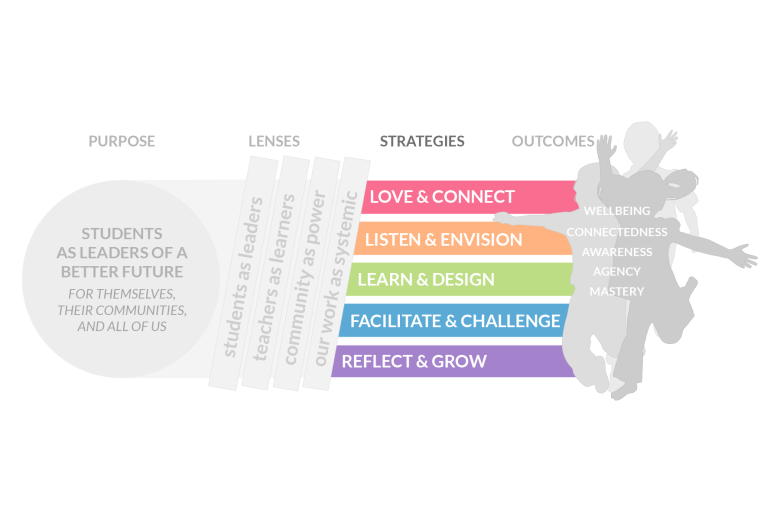
We have identified patterns in the actions teachers take in classrooms where students are growing as leaders of a better future. These transformational classrooms have shown that growing students in this way calls for more relational, student-led, discovery-oriented teaching and learning.
Discover
Check out this compilation of clips from some of the teachers, students, classrooms, schools, and communities that were part of our Global Learning Loops. What do these classrooms have in common? What key strategies do you see?
Learn
Our studies suggest that five families of actions (which we are calling “strategies”) distinguish transformational classrooms. Under each of these, you will observe five specific actions (for a total of 25 actions) often found in these classrooms.
|
Love & Connect |
|
Build relationships |
|
Foster belonging |
|
Nurture culture |
|
Know yourself |
|
Be human |
|
Listen & Envision |
|
Broaden perspectives |
|
Host dialogue & discussion |
|
Partner with families & community |
|
Critically examine history |
|
Collectively envision success |
|
Learn & Design |
|
Build critical knowledge |
|
Plan backwards |
|
Value learner variability & ownership |
|
Expect higher-order thinking |
|
Leverage learning theory |
|
Facilitate & Challenge |
|
Facilitate effectively |
|
Manage norms & rituals |
|
Foster collective discovery |
|
Flexibly adjust course |
|
Monitor learning & progress |
|
Reflect & Grow |
|
Take care of yourself |
|
Pause & reflect |
|
Find & foster allies |
|
Seek feedback |
|
Learn & unlearn |
“It turns out, if you are a teacher working to help students improve their lives and their communities’ futures, you do things very differently than teachers who are working to raise test scores.”
— Franco Mosso, CEO & Co-founder, Enseña Perú

“It turns out, if you are a teacher working to help students improve their lives and their communities’ futures, you do things very differently than teachers who are working to raise test scores.”
— Franco Mosso, CEO & Co-founder, Enseña Perú
Do
Explore an emerging toolkit of strategies for developing student leadership designed for teachers and teacher coaches, and other recommended resources:
TACL
Why: Collective, Contextualized Vision
Through this video from 2014, virtually visit communities and classrooms around the world and learn from educators, families, and students about the power of asking WHY. Explore the power of contextualized visions of student success to inform classro...
TACL
Teacher and Students, Growing Together
This article from 2015 uses Empieza Por Educar fellow Óliver Jabato's experience to reflect on two patterns we see in transformational classrooms around the world: collective ownership (teachers and students sharing ownership of learning) and student...
TACL
What Leadership Do We Need Now?: Voices From the Teach For All Network on How We Can Shape a Better Future
This book explores the kind of leadership we need to develop in our students, teachers, and ourselves through the perspectives of teachers, students, alumni, and staff members from across the network.
TACL
Darlin Asprilla: Community at the center of system leadership
In this video from 2018, discover what Darlin Asprilla, a former Ministry of Education staffer and Enseña por Colombia alumnus, has to say about the importance of placing the community at the heart of systems leadership.
Share
To share your insights, questions, resources, and challenges related to developing visions of student success, create a post on our Padlet using the "+" icon.
In this Padlet, the content is both user-generated and subject to moderation to ensure a safe and engaging experience.

Our Glossary
In our attempt to capture the real spirit of the classrooms we have studied, we have sometimes intentionally used words and phrases in a slightly unusual way.
We invite you to learn more about our language choices by exploring our Glossary.