All Resources
Find resources from all of our focus areas in one place
Girls' Education
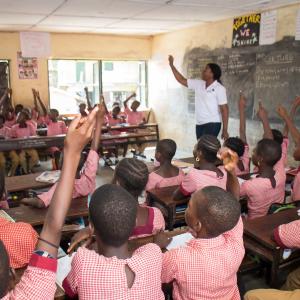
Gender Responsive Pedagogy: A Toolkit for Teachers and Schools
This toolkit builds on best practices from recent gender responsive pedagogy toolkits and research on gender-responsive education in the African context. It is a reference for teachers and school management to create inclusive classroom environments.
Inclusive Education
Universal Design for Learning: A Teacher's Guide
This article highlights the purpose of Universal Design for Learning (UDL), what it looks like in the classroom, and the principles of UDL that emphasize learner variability. It also looks at how families can support student learning through UDL.
TACL
Herramienta de autorreflexión para docentes
Esta herramienta pretende ayudar a docentes a ser más conscientes de los supuestos subyacentes que influyen en su forma de ver a los estudiantes, a sí mismos, a su comunidad y a su trabajo. La herramienta pretende ayudar a docentes a "establecer...
Girls' Education
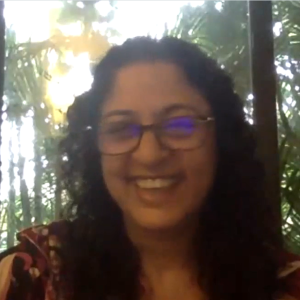
Teach For All Talk: Safeena Husain
A Teach For All Talk featuring the founder of Educate Girls in India. The talk provides great insight into Educate Girls' community-based model for changing beliefs and expectations for girls in rural India.
Community Impact Lab
Introduction to Teach For All: Examples of Impact From Across Our Network
Teach For All report detailing how 13 network partners have grown collective leadership to influence systemic change in their local, regional or national systems

TACL
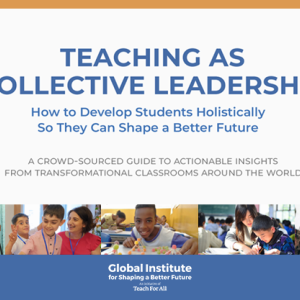
Teaching As Collective Leadership (TACL) Guide
Over the past six years, more than 4,500 students, teachers, teacher coaches, community members, program designers, CEOs, researchers, and policymakers from across and beyond our network of 60+ partner organizations have contributed to these crowd-so...